


The facelift was first introduced in the early 1900s, and consisted of a small incision in front of the ear where loose excess skin was removed. Systematic advances throughout the years have improved this basic technique to the point where, in the last ten years, there has been an explosion of new methods and techniques. As a result, patients may become confused with different opinions and options. I am very clear on what I offer and why in facial rejuvenation and have written this document to clarify all of this.
The Reasons for Facelift
The time honored reasons for seeking facelift are to correct loose, hanging folds of skin. In addition laxity of the ligaments (SMAS) and muscles can be addressed as well as issues with bony foundation such as small cheek or chin bones. Facelift can address fat in the face by removal of the fat between the muscle and skin (subcutaneous fat) by liposuction as well as removal of buccal fat pads or subplatysmal neck fat (deep fat).Modern facelift and eyelift techniques also address faces with thin or wasted features by the use of fat grafting which is permanent. The incision is artistically and functionally designed according to the features that need to be addressed and is limited to the shortest line possible. The incision is further designed with you in mind as a lifelong patient of mine so that the same lines may be used years later if you desire a repeat surgery and still want to look natural.
The Natural Facelift
Many doctors talk about creating a natural facelift and about what they think will serve you best. But there is a big difference between words and results. I take great pride in allowing a lot of time and conversation and education with my patients prior to facelift. The options are discussed and the plan chosen depend on your expectations and what your anatomy will allow me to do safely and predictably. A natural facelift means to me that you look the way you want to, like yourself just younger and refreshed and rejuvenated in keeping with how plastic surgery supports your total well-being goals and not altering them. It means to me well hidden incisions, a hairline and sideburn that is not pulled back, natural mouth and expressions, and normal ear cartilages and earlobes. My results and photographs clearly demonstrate this.
Anatomy of the Face
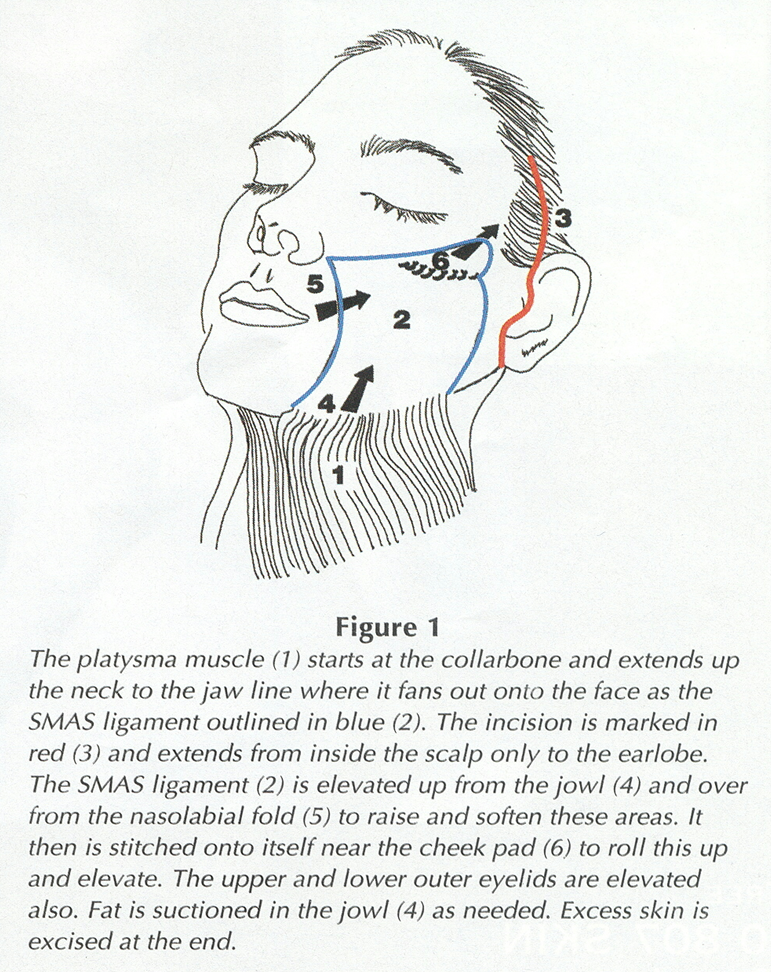
The anatomy of the face as it concerns the facelift deserves some review. Examination of your own face can be the same as what I do in the office and should focus on skin, subcutaneous fat, muscle tone and underlying bony foundations. Evaluate the skin not only for its texture, but also take care to note the elasticity, folds, looseness and mobility. The subcutaneous fat is mostly localized to the areas of the face off to the side of your laugh lines, and settles over time and with gravity into the jowl and can hang over the border of the jaw and onto the neck. In addition, note the fat in the cheek pads that can descend, as well as the fatty accumulations that may be present in the cheeks in front of the ears. Muscles are most importantly evaluated in the midline of the neck (see Figure 1).
While looking in the mirror at your neck, clench your teeth and push down the corners of the mouth. This tightens the platysma muscle of the neck, which is like a sheet on each side running from the collar bone up to the jaw line. The platysma muscle stops near the jaw line, where it continues onto the face as a very important ligament called the superficial musclo aponeurotic system (SMAS). This ligament is used very artistically in the modern facelift surgery for internal or deep support, which will be described in the following section.
Performing this clenching maneuver will make apparent or stand out any “bands,” or double folds, in the midline neck—if they are present. These are minimally improved with the mini-facelift—all the more reason why patients without these bands get a great result. Patients with these bands are served well with the standard facelift. Finally, evaluate the jawbone and cheekbones. Sometimes, when the skin is tightened and fat removed, underlying bony asymmetries can be uncovered, which I am always careful to identify and point out to patients before any surgical procedure. In these cases cheek or chin implants may be a worthwhile addition.
If your face or eyelids are thin or caved in, fat grafting can be performed. This procedure may be done at the same time as facelift or later. It is very state of the art and allows for adding volume and roundness and fullness to the eyelids or face as needed.
The treatment of localized fatty accumulations in the face and neck can be done with liposuction, with very dramatic and natural results through the same facelift incision or other tiny (2 mm) incisions. Fat also exists below the muscles in the neck (sub-platysmal fat) or in the middle of the face (buccal fat pads) that can be removed surgically during the procedure.
Who is a Candidate?
It is fairly straightforward determining who is a candidate for this procedure. I focus on the main areas that predictably can be improved or softened with the modern facelift in this order: excess sagging skin in the cheeks, jowls and jaw line; the deep laugh line; descending cheek pads; hanging loose folds of skin; hooding, loose skin of the upper outer eyebrows and eyelids. Other common features such as drooping of the corners of the mouth, fine wrinkle lines, smoker’s lines, small chin and cheek bones can also be improved at the time of facelift.
I teach patients to examine themselves and make a decision with the help of the “lift and pull test,” which is easy to do. Looking straight ahead into a mirror, place the hands along the cheekbones to the jowls then gently pull straight back and lift up. If there is much laxity and a significant and natural improvement is seen in the main features described above, then a facelift is an excellent solution. Note how much laxity and change is produced above the jawline and below. Notice how much of a fold of skin is produced in front of the ear or behind the ear. This will determine how much skin can be removed and the location and length of your incision line.
There are several variations and types of facelifts but they all serve to address in some form or other the above features. The options and specific technique will be explained to you in detail in the course of your office consultations.
The Procedure
Surgery is performed in the hospital with a very safe general anesthetic customized by me and administered by an expert MD anesthesiologist hand-picked by me. The facelift incision is custom-designed to best address the specific areas to be improved. It generally follows a line inside the temporal hair down to the upper ear edge, neatly along inside the ear cartilage, and down to the earlobe. From here it may extend slightly up behind the ear, or even over into the hair behind the ear if there is a lot of laxity. The length of the incision behind the ear depends on the amount of excess skin in the neck.
Working through this incision, a space is made under the fat and above the SMAS ligament (see Figure 1) for a certain distance only as far as needed—usually about two inches—until the relaxed fibers of SMAS ligament and cheek pad are identified. I tug on these with forceps to test for improvement while looking at the changes in the face until this looks natural and refreshed. Then I sew the ligament and the cheek pad up and back internally to maintain this result. This maneuver tightens the SMAS ligament, which is connected to the sagging jowl, elevates and emphasizes the cheek pad, and flattens the deep laugh line. This is the same internal or deep surgery that routinely is done on the minimal, standard and deep facelifts that has shown to provide better and longer-lasting results. Any excess fat in the jowls and neck is then liposuctioned through the same incision. Since most of the tightness to the elevated tissues is distributed along the stitches that have been placed in the sturdy SMAS ligament, the skin can be laid gently up in place under no tension, and the excess is neatly trimmed and the edge carefully stitched into place. This decreases the likelihood of wide scars and promotes incisions that heal, for the most part, imperceptibly. After finishing a light dressing is used.
Recovery is comfortable and relatively rapid due to a combination of factors: a very light general anesthetic, good long lasting local anesthetic, awakening from surgery with no pain, minimal dressings, less disturbance of facial tissues, less swelling, less bruising, and better patient preparation (diet and vitamins) and post-op care (ultrasound, skin care). Usually only mild discomfort is present and lasts for 2–3 days. I counsel each patient that if surgery is performed on a Thursday or Friday, the majority of the recovery happens over the weekend. This allows the patient to return to some activity and maybe even light work by the middle of the next week with minimal or no bruising and only mild swelling. The patient can shower by the second day and camouflage makeup can be applied as early as the second or third day. On a professional level, I have learned the importance of carefully supervising lifestyle, diet and nutritional supplements both before and after surgery. Longevity of this procedure is excellent. I have noticed that most patients are relatively younger and they seek a more active relationship with my skin care clinicin their skin health and care to help maintain and preserve the facelift results. Often, this is a procedure where having surgery earlier in life does seem to contribute to the procedure’s longevity. Most patients find that if revisions are needed, they usually only involve a minor facelift instead of a full facelift. However, a full facelift can still be done at a later date, and is usually safer, easier, can be more aggressive and lasts longer than the previous facelift.

I’m really enjoying the design and layout of your website.
It’s a very easy on the eyes which makes it
much more pleasant for me to come here and visit more often. Did you hire out a designer to create your website?
Great work!