The belly button (“umbilicus” or “navel”) is a concave area in the mid section of the abdomen. In its depth there is an irregular network of soft scar tissue that is the usual, and results from where your umbilical cord normally separates at birth. It is particularly conspicuous, and it is very important to look normal and youthful. It is most often seen as a vertical oval shape, not too large oval with smooth contours and no folds or wrinkles. Abnormal features of the umbilicus can be related to two things; birth anatomy and acquired deformities.
BIRTH ANATOMY
Depending on the nature of your anatomy and how the umbilical cord separates at birth, there are several features you can be “born with”. This can be due to several factors that may occur in combination or separately. It can have a very large round umbilical “ring”. It can have an unusual oval – longer or wider, not as round shape. It can have a bulge or “button” in the middle and not have the normal concave shape and this bulge can be total or partial or big or small or off to one side. This bulge is due a small hernia (an opening to the depths of your abdomen) where some of the fat pushes through a small ring and creates a dome or “outie”. This hernial abnormality can vary in terms of size and shape. Additionally, there may be excess skin wrinkles or folds or creases. These can come from pregnancy, weight loss or just loose skin. There may be an umbilicus that is any shape or size or diameter or concave or bulging and all of these can be cured.
ACQUIRED DEFORMITIES
These are related to any cosmetic or surgical procedures that are performed in or around the edges or inside of the umbilicus. This includes piercing with jewelry, laparoscopic surgery scars, weight loss, previous hernia surgery or other procedures. Most often nowadays we are seeing patients requesting surgical reconstruction AFTER PIERCING. This condition occurs commonly. The anatomic deformity created here is not visible until after a piercing is removed. In this situation the pierced channel heals to itself and creates a sheet of scar tissue that extends from one hole of the piercing on the outside to the other hole inside the umbilicus. It is as if you take the jewelry out then pinch this area with your fingers and this is the fold or “hood” that persists. It can be corrected by removing the scar tissue track created by the piercing, making internal incisions, unfolding the upper “hood” of the umbilicus, removing the excess tissue, recreating the round umbilical ring, and sewing the edges back together. Correction of other scarring in and around the umbilicus is similarly treated.
SURGERY
The surgery for umbilicoplasty is very straightforward. Dr. Romano has performed hundreds of these operations with consistent excellent and permanent results and never a complication. All umbilical surgery is performed totally INSIDE the umbilicus to fix a hernia, remove a bulge, create more roundness or remove piercing or scars. You should not see any scars on the abdomen, and you should have a natural result with a natural shape umbilicus and a nice concave center. The anatomy of your umbilicus and what are your expectations will be reviewed carefully at the time of your examination. Dr. Romano will diagram exactly what will occur at your surgery, so you understand and agree to the plan. The surgery is performed under an excellent and comfortable Novocain local anesthetic. There is no other anesthesia needed, not even an IV. It takes about one hour. There are no visible scars, and all your incisions will be in the depth of your umbilicus. You will not have any pain before, during or after the procedure. You can return to work and some exercise the same day. You will see your result immediately and it just gets better in time. The result will be beautiful and natural for the rest of your life.
Here is the link to the website Belly button correction section if you have not already viewed it.
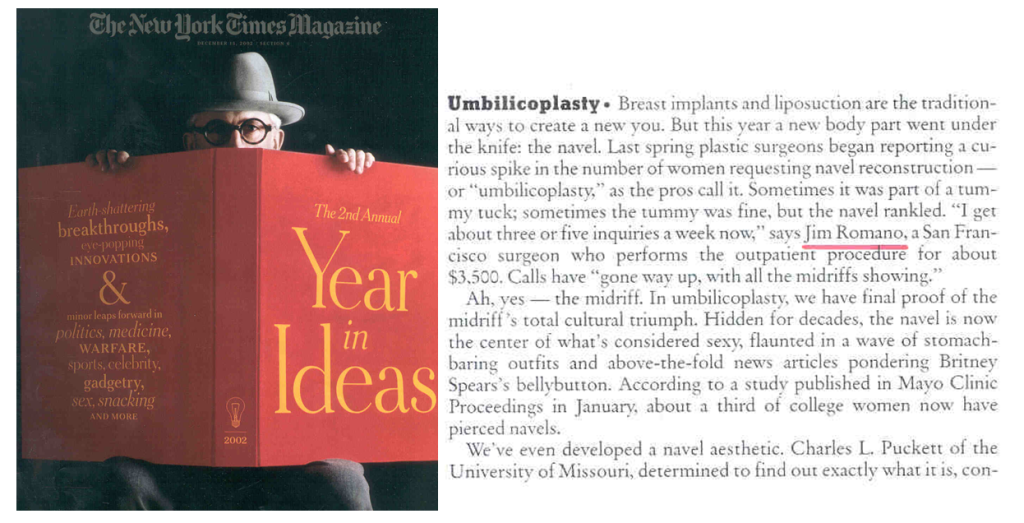
For any questions or to schedule a live or virtual consultation please call or contact the office. You can speak with Dr. Romano personally. info@sfplasticsurgery.org. 415 981 3911 Dr. Romano is quoted in The New York Times Magazine: